From your first musical ideas to confident improvisation
From Your First Notes to Confident Piano Improvisation
Imagine sitting down at the piano and making music without following a score. This self-paced piano improvisation course helps beginners and experienced players learn to play by ear, build expressive chord progressions and turn simple ideas into their own melodies.
Rather than asking you to memorise one piece after another, John Montgomery teaches you the building blocks of musical freedom. Start with just three notes, develop rhythm and melody, explore scales and piano chords, then practise improvisation over studio-recorded backing tracks. The lessons feature overhead keyboard demonstrations and animated scores, helping you connect what you see and hear with what your hands play. If you are new to the piano, begin at the beginning; if you already play, use the practical modules to become more confident playing by ear and creating original musical ideas.
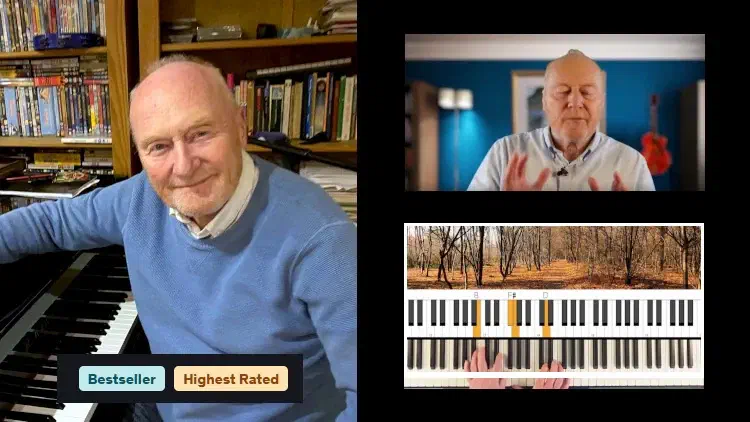
Learn to create, not just repeat
Why This Piano Improvisation Course Is Different
There is a difference between learning a piece and knowing what to play when the score disappears. John's lessons combine simple, practical demonstrations with just enough music theory to help you make your own choices on the keyboard.
Play instead of memorising
Start creating melodies from the very first lessons, then gradually develop the technique to make them more interesting.
Understand why chords work
Explore practical harmony and progressions, so you can find your way around more songs and invent your own.
Practise with real music
Use professionally produced backing tracks to experiment with rhythm, melody and expression.
See and hear every movement
Follow clear overhead keyboard demonstrations and animated scores, and repeat lessons whenever you need.
Try improvising right now
How to Improvise on Piano: A Simple Beginner Exercise
You do not need a complex piece of music to get started. Try this short exercise on any piano or keyboard to hear how small choices can become an original melody.
Choose a few notes
Find middle C and play C, D, E and G with your right hand. Keep a comfortable, steady pulse.
Give it a foundation
Play a lower C with your left hand at the start of each short phrase. Let the bass note support your melody.
Change the melody
Rearrange the four right-hand notes, vary the rhythm and leave occasional spaces. Repeat a favourite idea, then answer it with a new one.
That is the starting point of piano improvisation: listen, experiment and develop a musical idea. In the full course, John Montgomery demonstrates how to expand this approach using chords, different time signatures, two-hand patterns and backing tracks.
Free lessons to try before you enrol
Practise Piano Improvisation with These Beginner Guides
Start with a short lesson that answers the question you have today, then return to the course curriculum for a structured path through chords, rhythm, melodies and hand independence.
- How to start improvising on piano — five manageable exercises for your first melodies.
- Piano chord progressions for beginners — play four useful harmonic loops.
- How to improvise with both hands — coordinate a steady bass with a simple melody.
- Pentatonic scale improvisation — make music with five notes.
- Playing piano by ear after classical training — use your reading skills as a foundation for creative playing.
- Free daily piano improvisation challenge — practise with a browser-based chord loop and drum rhythm.
A clear path from your first note
What Will You Be Able to Play?
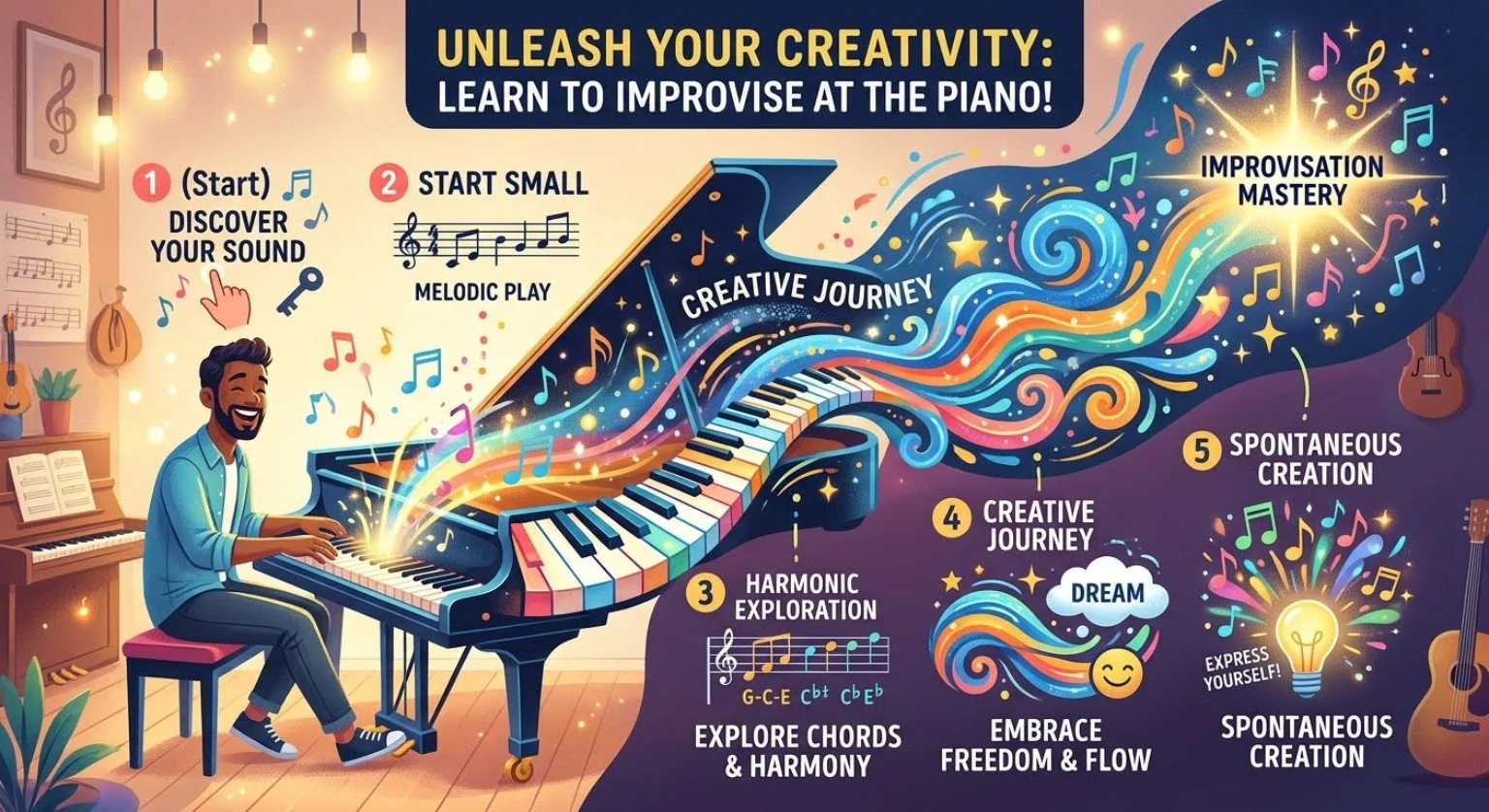
From three notes to a real melody
Find notes, settle into a comfortable hand position and create a musical question and answer.
Add pulse, bass and chord progressions
Explore different rhythms while your left hand supports increasingly confident improvisation.
Give your music its own character
Combine melody, harmony, touch, arpeggios and musical intervals to shape a distinct sound.
Watch, listen and play along
Learn Piano Improvisation with Practical Video Lessons
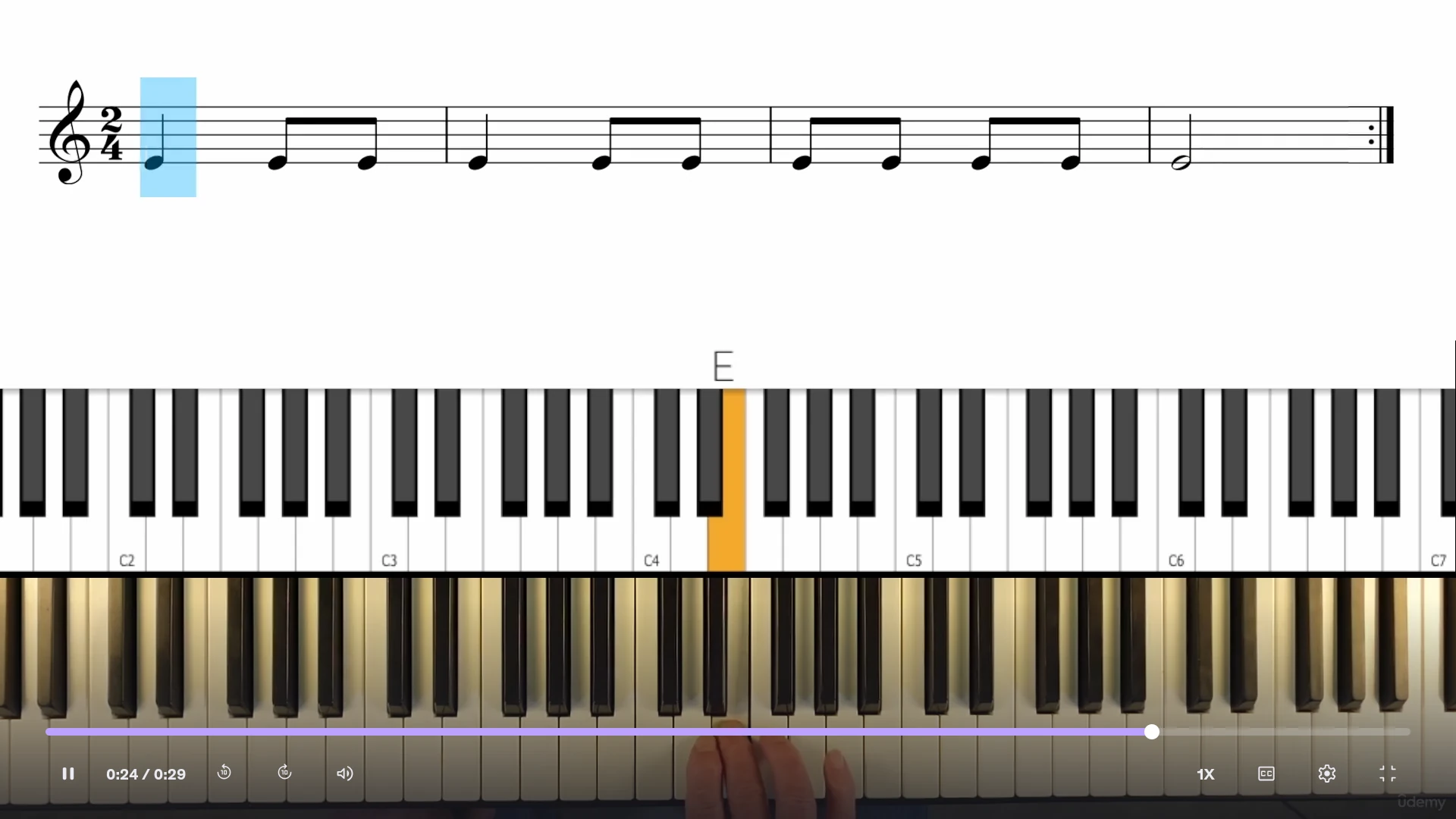
Overhead Piano Demonstrations
Watch detailed overhead piano demonstrations showing exactly where each finger lands. Follow along at your own pace and develop confidence as you learn new techniques and musical ideas.
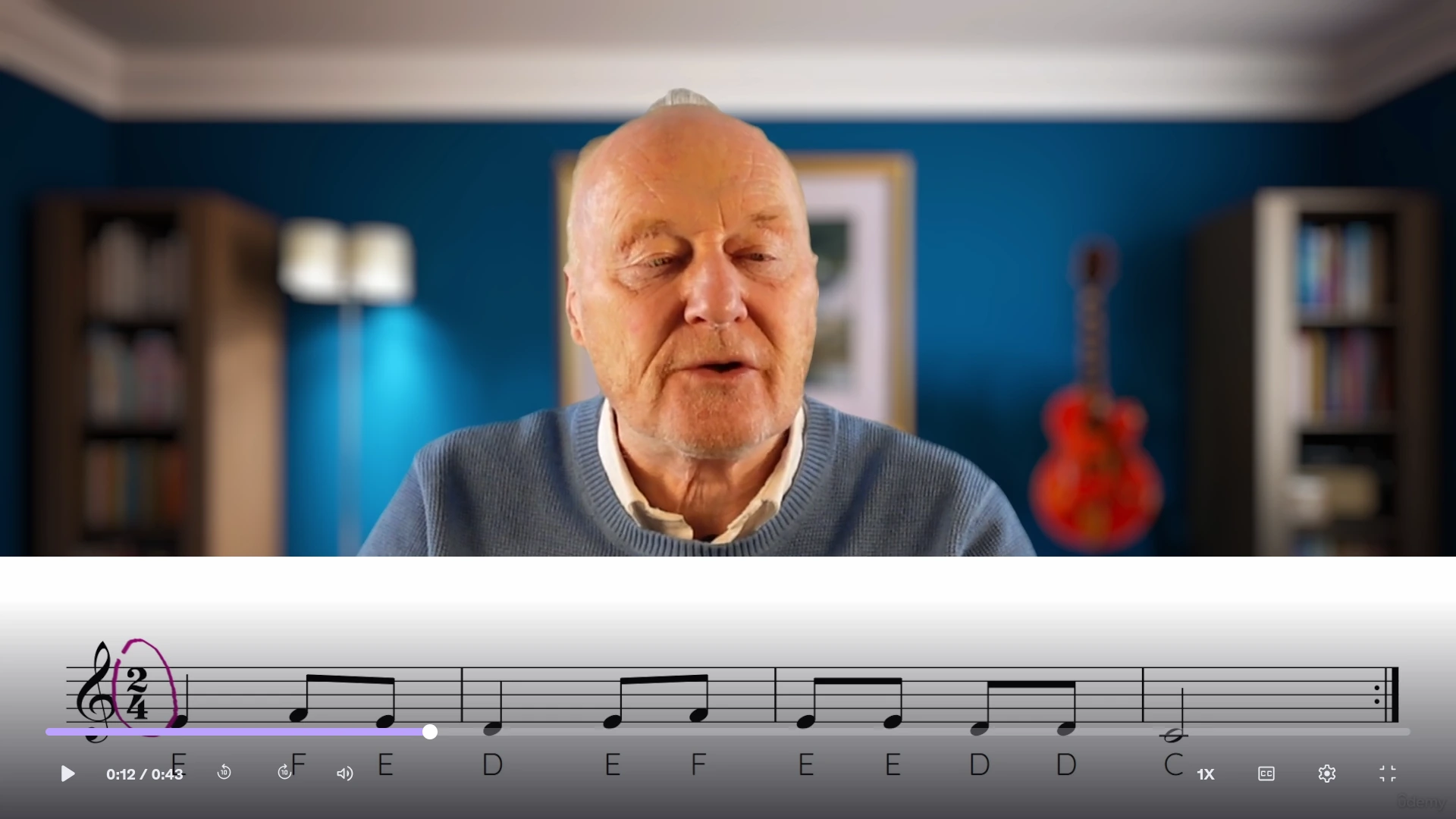
Animated Piano Scores
Follow animated music notation synchronized with the piano demonstrations. Connect written notes with the sounds you hear and develop your ability to read, understand and perform music.
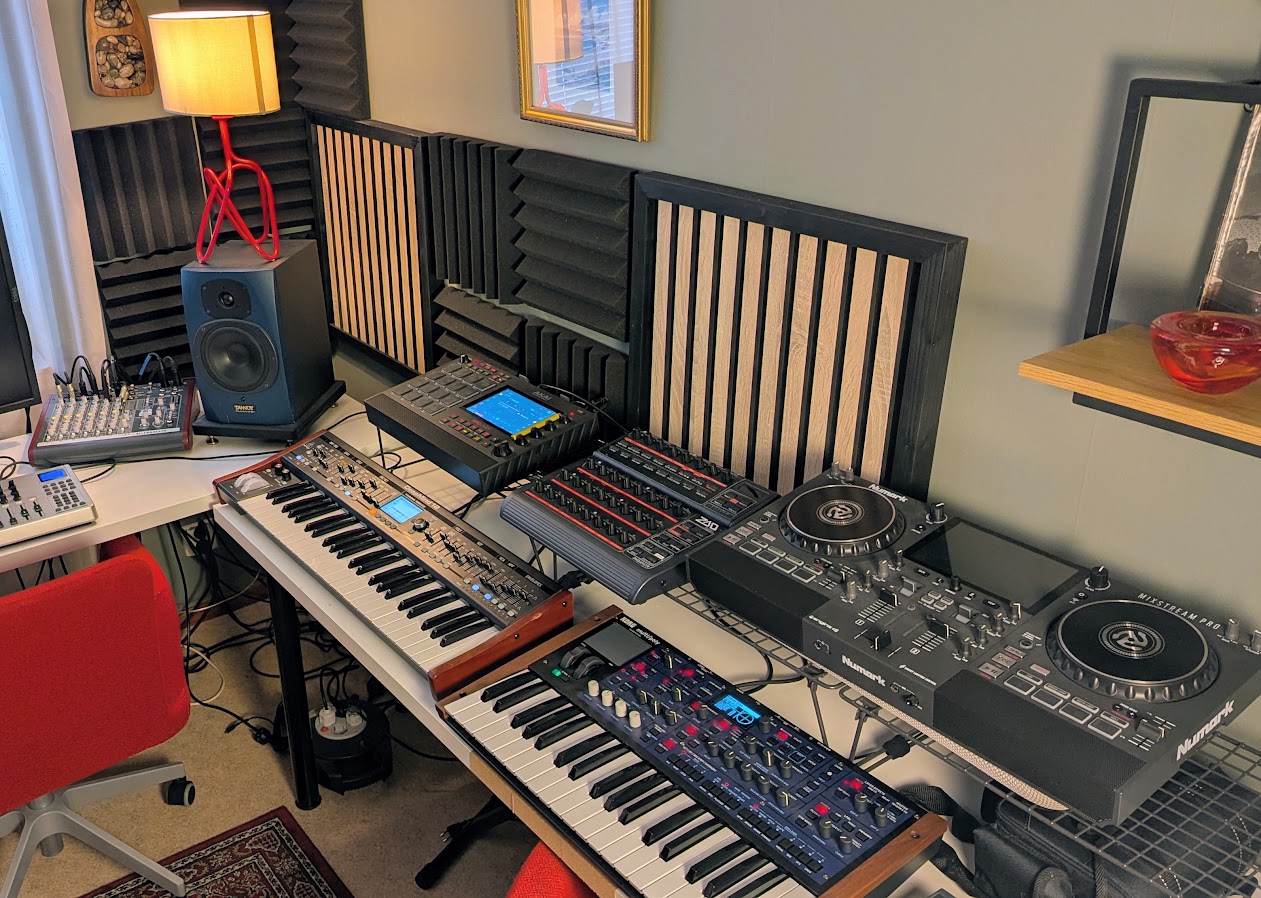
Studio-Recorded Piano Backing Tracks
Practise piano improvisation with studio-recorded backing tracks. Explore different rhythms, chord progressions and musical ideas while playing alongside a full-band sound.
A substantial, practical learning programme
Explore the Piano Improvisation Course Curriculum
With 15 sections and 110 lectures on Udemy, there is plenty to discover. Open the sections below to see specific lesson subjects, exercises and the musical skills they develop.
01 Start playing: find your way around the keyboard
Get comfortable at the piano without waiting until you can sight-read. Begin with three notes, expand into a five-note melody and learn the C major scale while your left hand supplies the first musical support.
Your goal: Play your first improvised melody, recognise the notes quickly and give your right hand a simple bass foundation.
Skills covered
- Relaxed posture, curved fingers and keyboard landmarks
- Legato versus staccato touch
- Three-note and five-note melody building
- C major scale and octave awareness
- Left-hand root, fifth and octave bass patterns
Lesson programme
- Piano Posture & Hand Position: Play Comfortably
- Piano Keyboard Layout: Find Any Note Without Sheet Music
- Legato & Staccato: Play Smoothly and Clearly
- Your First Piano Improvisation: Create a Melody with 3 Notes
- Improvise with 5 Notes: Start Creating Music
- C Major Scale: Play Your First Octave Scale
- Left-Hand Piano Bass: The 1-5-1 Pattern
02 Make your playing groove with rhythm
Learn how pulse, accents and note lengths turn a collection of notes into music. Try driving 2/4 grooves, flowing waltz patterns in 3/4, pop-friendly 4/4 and rolling compound time in 6/8.
Your goal: Keep a solid pulse and improvise confidently in several common time signatures.
Skills covered
- 2/4 downbeats, off-beat accents and syncopation
- 3/4 waltz feel, dotted half notes and subdivisions
- 4/4 grooves with quarter and eighth notes
- Dotted rhythms and sixteenth-note patterns
- 6/8 compound time and a rolling rhythmic feel
Lesson programme
- 2/4 Piano Rhythm: Master the Pulse & Downbeat
- 2/4 Piano Rhythm: Learn Syncopation & Off-Beat Playing
- Piano Rhythm Practice: Quarter & Eighth Notes with Backing Track
- 3/4 Piano Rhythm: Create Flowing Melodies
- 3/4 Time: Dotted Half Notes
- Master the Waltz Feel: 3/4 Timing Made Simple
- Grooving to a 4/4 Time
- Subdividing 4/4: The Eighth-Note Flow
- Combining Dotted Quarter Notes with Eighth Notes
- Compound Time: Discover 6/8
- Different Rhythms: Dotted Eighth and Sixteenth Notes
03 Unlock the black keys
Understand sharps and flats without complicated memorisation. Learn the distance between adjacent notes and use semitone movements as expressive details in your playing.
Your goal: Use all the keys on the piano to add colour and expressive movement.
Skills covered
- Sharps, flats and enharmonic names
- Whole steps and half steps
- Understanding the E–F and B–C exceptions
- Decorating melodies with chromatic notes
Lesson programme
- Piano Sharps & Flats: Master the Black Keys
04 Create melodies that tell a story
Discover call-and-response phrases, repeating musical ideas, rhythmic variation and the role of touch and sustain pedal. Practise turning short motifs into longer musical statements.
Your goal: Move beyond exercises and shape improvised phrases that sound purposeful and expressive.
Skills covered
- Sustain pedal control, legato and staccato
- Call-and-response and motif development
- Phrasing and melodic shapes in 2/4 and 3/4
- Pop-inspired phrases and syncopation in 4/4
- Flowing melodic lines over 6/8 backing tracks
Lesson programme
- Piano Sustain Pedal: Create Smooth, Professional Sound
- Touch and Texture: The Art of Legato and Staccato
- The Call and Response Method: 2/4 Melodic Phrasing
- Developing Melody in 2/4 Time
- 2/4 Piano Improvisation: Create Driving Melodies
- 3/4 Piano Improvisation: Create Soaring Melodies
- 3/4 Melodic Mastery: The Cinematic Ballad Performance
- The 3/4 Groove with an Octave C
- The Pop Anchor: Building Strong Melodies in 4/4
- Exploring More Notes in the 4/4 Groove
- 4/4 Piano Improvisation: Build a Complete Musical Story
- Create Smooth Piano Melodies with the Rolling Lead
- 6/8 Piano Improvisation: Create Flowing, Emotional Melodies
05 Understand scales, keys and the building blocks of harmony
Learn why certain notes fit together. Build major scales, explore relative minor, navigate keys with the circle of fifths and add rich colour through pentatonic, whole-tone and chromatic ideas.
Your goal: Choose notes and chords more deliberately, rather than relying entirely on trial and error.
Skills covered
- Major scales and the whole/half-step formula
- Relative major and minor keys
- Circle of fifths and neighbouring keys
- Triads and chord inversions
- Pentatonic, whole-tone and chromatic scales
Lesson programme
- The Major Scale: Build Your First Scale
- Major & Relative Minor: Create Different Moods
- The Harmonic Compass: Navigating the Circle of Fifths
- The Triad Claw: Build Major & Minor Chords
- The Art of the Flip: Master Chord Inversions
- The Shadow Chords: Mastering D Minor and E Minor
- The Improviser's Safety Net: The 5-Note Pentatonic Scale
- The Dream State: Mastering the Symmetrical Whole Tone Scale
- The Total Palette: Mastering the 12-Note Chromatic Scale
06 Build compelling piano chords and progressions
Learn the progressions that drive countless songs, from I–IV–V to I–V–vi–IV and ii–V–I. Discover how inversions, suspended chords, major sevenths and inner voices help a simple idea sound fuller.
Your goal: Make chords flow smoothly beneath your melodies and create pop, soulful, jazz-influenced and cinematic textures.
Skills covered
- Two-chord and three-chord improvisation
- I–V–vi–IV pop chord loops
- Smooth inversions and voice leading
- Major-to-minor colour, ii–V–I and minor iv
- Sus2, sus4, major seventh, augmented and diminished chords
- Right-hand harmony and the circle of fifths
Lesson programme
- 2 Chords: Improvise Your First Melody
- The Pop Loop: Mastering the I–V–vi–IV Progression
- The 3-Chord Trick: Use Inversions to Create a Groove
- The 4-Chord Loop: Master an Endless Progression
- Seamless Harmony: Advanced Inversions for Professional Flow
- Major to Minor: Master the Bittersweet iv Chord
- The Breath of Music: Mastering Sus2 and Sus4 Chords
- Major 7th Chords: Add Colour to Your Piano Playing
- The Inner Voice: Using Your Thumb for Harmonic Texture
- Right-Hand Piano Harmony: Add Chords Under Your Melody
- The Circle of Fifths: Navigate Chords & Keys
- Augmented & Diminished Chords: Create Tension & Release
07 Get the feel of the 12-bar blues
Learn the character of dominant-seventh harmony, understand the shape of the 12-bar blues and practise returning to the start of the progression with a turnaround.
Your goal: Follow a blues progression and give your playing a more soulful harmonic sound.
Skills covered
- Dominant seventh chords
- Three-phrase 12-bar blues pattern
- I7, IV7 and V7 changes
- Turnarounds and staying in time
Lesson programme
- Dominant 7th Chords: Get the Blues Sound
- 12-Bar Blues: Master the Essential Chord Progression
08 Bring both hands together
Start with both hands playing together on the beat and gradually weave notes between beats. Add syncopation and broken left-hand patterns to achieve a more continuous piano texture.
Your goal: Play a more independent right-hand melody over a reliable left-hand accompaniment.
Skills covered
- Steady bass notes and independent melody
- Notes that land together and notes between beats
- Off-beat accents and rhythmic interlocking
- Combining bass motion with a melodic line
Lesson programme
- Two-Hand Independence: Play Left & Right Together
- Mastering Hands Together
- The Final Merge: Combine Bass & Melody
09 Create flowing, atmospheric arpeggios
Explore rolling patterns, root–fifth–octave shapes, wide-spaced voicings and sensitive pedalling to give your improvisations a fuller and more spacious sound.
Your goal: Turn block chords into rippling, expressive accompaniment.
Skills covered
- Root–fifth–octave foundations
- Broken chord and wider-spaced patterns
- Cross-hand motion and flowing textures
- Sustain pedal for resonant playing
Lesson programme
- Liquid Harmony: Create Flowing Piano Arpeggios
10 Shape musical emotion with intervals
Recognise major, minor and perfect intervals at the keyboard and discover how the same melody can feel brighter, more tense or more reflective when the spacing between notes changes.
Your goal: Hear and use the distances between notes to give melodies a clearer emotional direction.
Skills covered
- Major seconds, thirds, sixths and sevenths
- Perfect fourths, fifths and octaves
- Minor seconds, thirds, sixths and sevenths
- Using interval sounds as melodic choices
Lesson programme
- Major Intervals: Build More Expressive Melodies
- Minor Intervals: Add Emotion to Your Melodies
The 10 detailed sections below are confirmed from the public Udemy syllabus (61 listed lectures, plus accompanying quizzes). The full course currently contains 15 sections and 110 lectures; Udemy hides the remaining five sections from the public preview. See the current full listing on Udemy for additional sections.
View the current full syllabus, preview videos and enrolment options on Udemy.
Ready to make music of your own?
Find your own way around the keyboard with a practical video course taught by John Montgomery.
Everything works together
What Is Included in the Course?
- Clear overhead camera angles showing John's hands as he demonstrates.
- Animated notation alongside practical, listen-and-repeat examples.
- Studio-recorded backing tracks to make practice feel more musical.
- Downloadable PDF score resources where provided by the course.
- Flexible, self-paced lessons accessed through Udemy.
Learn at your own pace
Who Is This Piano Course For?
Whether you are taking your first steps on the piano or can already play pieces by reading music, this course is designed to develop your ability to improvise.
- Complete beginners who want to start making music straight away.
- Self-taught players who want to understand chords and play by ear.
- Readers of sheet music who would like to improvise more freely.
- Keyboardists, composers and music producers building original musical ideas.
Good to know before you enrol
Piano Improvisation Course: Frequently Asked Questions
Can I start this course without playing piano before?
Yes. The course begins with posture, note recognition and very short musical ideas before introducing chords, scales and coordination. If you already play, you can start from the material most relevant to you.
Do I need to read sheet music?
No. Playing by ear and improvisation are central. Notation and optional score resources support your learning, rather than acting as an entry requirement.
What equipment do I need?
A piano or electronic keyboard and a way to listen to the lessons. Speakers or headphones are helpful when practising with backing tracks.
What musical styles will I explore?
The lessons include pop-style chord progressions, basic blues harmony, soulful and cinematic piano textures, flowing ballad-style arpeggios and rhythm-based improvisation.
Will I be able to practise with backing tracks?
Yes. Studio-produced backing tracks are a distinctive part of the teaching method, letting you practise timing and original musical ideas in a musical setting.
Where do I take the course and watch the lessons?
The lessons and course resources are hosted on Udemy. Follow any enrolment button on this page to see the current price, preview videos and full curriculum there.

Meet your piano improvisation teacher
Learn Piano Improvisation with John Montgomery
John Montgomery of Softplanet Productions brings thirty years of experience playing, composing, arranging and teaching music. His practical approach helps piano students develop musical confidence, understand the keyboard and discover the freedom of improvisation.
See the Full Course & Enrol on Udemy